 Hush Pantry
Quiet, practical food advice
Hush Pantry
Quiet, practical food advice
Hush Pantry
Quiet, practical food advice
Hush Pantry
Quiet, practical food advice
For overnight workers who want a practical food, fluid and caffeine plan. A downloadable 36-page PDF.
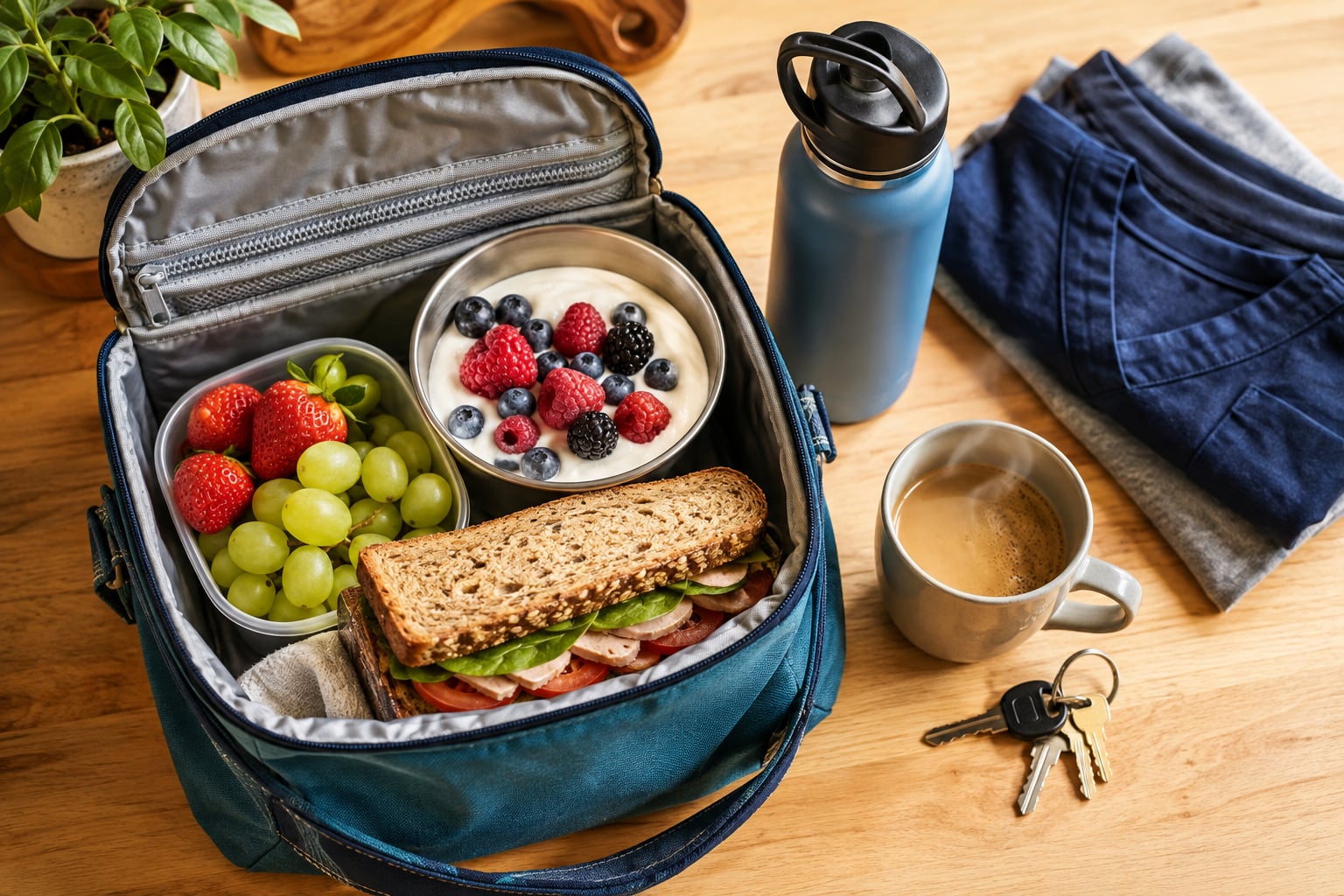
Your working hours run through the time most meal advice assumes you are asleep. Fixed meal times do not tell you what to do when you are hungry at work or heading home to bed. Without a plan built around your shift, each night can mean making those choices again.
Start with your intended sleep time, then work backward through the food and work anchors that matter to you.
Place food and work anchors around your intended sleep time instead of following somebody else's clock.
Choose what to eat during a shift based on what you need, rather than treating the night as a second dinner.
Work out when caffeine fits earlier in your shift with sleep after work in mind.
Adjust the map to your working pattern instead of starting from fixed daytime meal times.
Review what did not fit your shift and test an adjustment to the plan.
The guide has eight chapters. The first two are shown in full below so you can judge whether the approach fits before buying.
Imagine a 12-hour shift that starts at 7 p.m. You wake in the late afternoon, hurry through getting ready, and leave with coffee but no proper meal. At 10 p.m., the ward, control room, cab, patrol, or warehouse gets busy. Your planned break moves. By 1 a.m., you are hungry enough to eat quickly, so the largest meal of your day lands in the middle of the night. At 3 a.m., your eyelids feel heavy and something sweet looks like the fastest answer. At 5 a.m., another coffee seems reasonable. Then you get home tired, hungry again, and hoping to sleep soon.
None of those decisions means you lack discipline. Night work puts several ordinary pressures in the same small space: tiredness, real hunger, uncertain breaks, limited shops, food that needs heating, and a body that still expects darkness to be a time for sleep. A plan designed around a calm daytime kitchen will struggle here.
You arrive underfed. If the hours before work contain little more than a snack, you may spend the first half of the shift catching up. Food decisions then happen when you are already hungry and short of time. A warm bowl of rice with crisp-edged tofu or chicken, bright vegetables, and a spoonful of sharp yogurt sauce before work is very different from trying to build dinner out of vending-machine bits at 2 a.m.
You graze because the night has no clear meal. A biscuit in the break room, a few sweets at the desk, then half a sandwich can add up without ever feeling like you sat down and ate. Research on night workers suggests that habits, opportunity, and social breaks can shape eating as much as appetite. The useful response is not to ban shared food. It is to give the shift enough structure that every passing snack does not have to stand in for dinner.
Your biggest meal lands in the biological low. Public-health guidance for shift workers generally leans toward keeping substantial meals closer to daytime and reducing food between midnight and 6 a.m. where practical. That is a direction, not a universal order to go hungry. A physically demanding shift, a long gap between meals, pregnancy, diabetes, medication, or a history of troubled eating all change what is sensible. This guide treats overnight food as support you can adjust, not a character test.
Caffeine follows fatigue all the way home. A small coffee early in the shift may help alertness. Repeated top-ups late in the night can still be active when you want to sleep, which sets up an unpleasant loop: poorer sleep, a harder next shift, then more caffeine. We will put a cutoff on the map before tiredness starts negotiating with it.
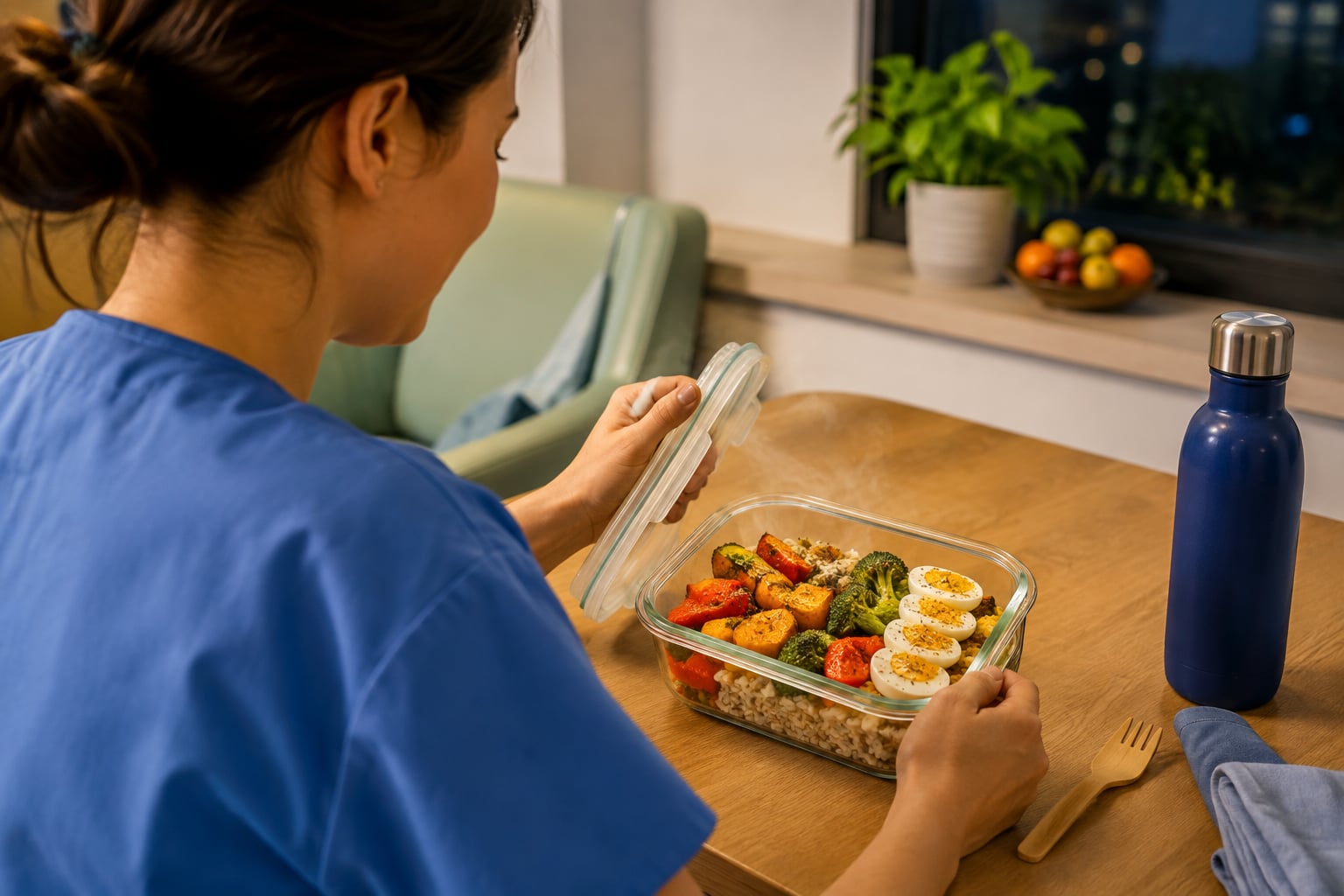
Eating before the shift can make hunger easier to manage. A lighter option overnight may feel more comfortable than a heavy meal. Water within reach can prevent the whole night from passing before you remember to drink. A planned caffeine stop can leave a better chance of sleeping after work.
These are helpful adjustments, not protection against an unsafe roster. Occupational-health guidance describes fatigue as a response to sleep loss and prolonged mental or physical effort, and says sufficient rest is what reduces it. Food cannot repay sleep debt. Coffee cannot reliably make a dangerously sleepy drive safe. If you are fighting to keep your eyes open, missing road cues, drifting in your lane, or struggling to perform safety-critical work, the answer is a safe rest and transport plan, plus workplace fatigue procedures where available.
Long-term studies often find that night workers have higher rates of several health problems than day workers. Those patterns matter, but they do not prove that a certain midnight meal caused an illness, nor that a perfect lunch box can prevent one. Shift length, sleep, stress, job conditions, activity, access to care, and many other differences can travel together. The more immediate promise of a food map is modest and useful: fewer improvised decisions, more comfortable eating, and a clearer boundary between staying fed at work and preparing to sleep.
Keep that composite shift in mind. We are going to move its decisions earlier, one at a time, beginning with why nighttime eating can feel different even when the food itself is familiar.
You can be fully dressed, answering messages, lifting boxes, checking observations, or driving a route while your body is still following nighttime instructions. That mismatch is the starting point for the whole map.
A circadian rhythm is a roughly 24-hour pattern in the body. It helps time sleep and wakefulness, but its reach is wider than that. Hormone release, body temperature, alertness, appetite, digestion, and the way you handle nutrients all change across the day and night. The lowest-alertness stretch often falls in the hours before dawn, although the exact timing varies from person to person.
A small area in the brain acts as the main clock. Light reaching your eyes is its strongest everyday time cue, which is why bright nights and dark days can pull against the sleep schedule you want. The body also has clocks in tissues and organs, including the liver and digestive tract. Researchers often call these peripheral or organ clocks.
Those clocks share information, but they do not all listen to the same cues equally. Light has a strong effect on the main clock. Regular eating and fasting times can help cue clocks in organs involved in metabolism. In a conventional day, light, activity, food, and sleep tend to point in a similar direction. During night work, the signals can split. Your eyes see workplace light and your hands unwrap a meal, while your central clock may still be marking biological night.
That does not mean every night worker is permanently out of sync or that a meal at night is inherently harmful. It explains why simply renaming 2 a.m. as lunchtime does not make the whole body respond as if it were noon.
The digestive tract has daily rhythms in movement, secretions, absorption, and bowel activity. Reviews of gastrointestinal research find that many of these functions quieten or change at night. Add a large, rich meal eaten quickly during a short break, and it is easy to see why some workers notice fullness, nausea, bloating, heartburn, or an urgent trip to the toilet. Others find constipation becomes more troublesome across a run of shifts.
A few practical details can soften the collision. A toasted whole-grain wrap with chicken or hummus, crunchy cucumber, and a little yogurt dressing is easier to portion than a large creamy takeaway. Sitting down for ten minutes, if the shift allows it, may feel better than eating quickly while walking. If spicy food or a very fatty meal repeatedly brings on reflux, you have a useful personal pattern to work with. You do not need to assume that everyone must avoid the same foods.
Symptoms still deserve ordinary medical attention. Persistent reflux, pain, vomiting, blood in the stool, continuing diarrhoea, or a marked change in bowel habits is not something to solve with a snack list.
After you eat carbohydrate, digestion releases glucose into the bloodstream. Insulin helps move that glucose into cells. Glucose tolerance describes how well the body keeps blood glucose within its usual range after a meal. Insulin sensitivity describes how readily cells respond to insulin. In general, human glucose tolerance is better during the biological day than at night.
Small laboratory studies make that difference easier to isolate than everyday workplace research. In one simulated night-work study, 19 healthy young adults followed controlled schedules for 14 days. People who ate during both day and night developed higher average glucose during simulated night work, while the group whose meals stayed in the daytime did not show that increase. The study was carefully controlled, but it was small, short, and did not recreate a busy ward, a haulage route, or months of rotating shifts.
Another simulated-shift experiment compared nighttime eating with avoiding food overnight. The work examined hunger, sleepiness, performance, and stomach upset as well as timing. Studies like these can show short-term responses under controlled conditions. They cannot tell every worker exactly when to eat, especially when physical labour, medication, pregnancy, diabetes, or a history of disordered eating changes the decision.
Chrononutrition is the study of how the timing of food interacts with the body's daily rhythms. It is a useful field, but the practical evidence for night workers is still developing. Controlled trials suggest a metabolic advantage to keeping more intake in the daytime. Real-world studies must contend with missed breaks, workload, sleep timing, commuting, family life, food access, and the fact that an overnight fast may be uncomfortable or inappropriate for some people.
Long-term observational studies add another kind of information. They can compare the health of groups who do and do not work nights, sometimes across years. They regularly find associations between shift work and poorer metabolic or digestive health. An association is a pattern, not proof of cause. People working nights may differ in sleep, stress, income, job demands, activity, and healthcare access, any of which can affect the result.
For your own map, hold three kinds of time at once:
That is why the next step starts with your actual sleep and work anchors, not a universal timetable. The science gives us a direction: keep substantial eating closer to the daytime where feasible and be thoughtful about food deep in the night. Your circumstances decide how far that direction can sensibly take you.
You have read chapters 1 to 2 of 8: why ordinary eating advice breaks at 2 a.m. and why your body clock still knows it is night. The rest covers building the map, choosing overnight fuel, caffeine, workplace realities, shift patterns and troubleshooting.
Build your food timeline from intended sleep and work anchors, not a standard daytime schedule.
Use job demands and hunger to guide overnight fuel instead of assuming you need a second dinner.
Think about caffeine earlier in the shift so your intended sleep time stays part of the decision.
Use the shift-pattern and troubleshooting chapters to revise a map that does not fit.
The 36-page PDF covers why daytime advice can miss the mark at night, how to map food and fluids backward from sleep, how to choose overnight fuel, when to use caffeine, and how to adapt and test the plan at work.
$3.97
Get the fuel map36-page PDF · no subscription · works on any device
Without a plan tied to your shift, you are left fitting nighttime decisions into daytime advice that was not made for your hours.