 Hush Pantry
Quiet, practical food advice
Hush Pantry
Quiet, practical food advice
Hush Pantry
Quiet, practical food advice
Hush Pantry
Quiet, practical food advice
For adults with a narrow set of accepted foods, this downloadable 31-page PDF starts with familiar meals and makes room for small, voluntary food experiments.
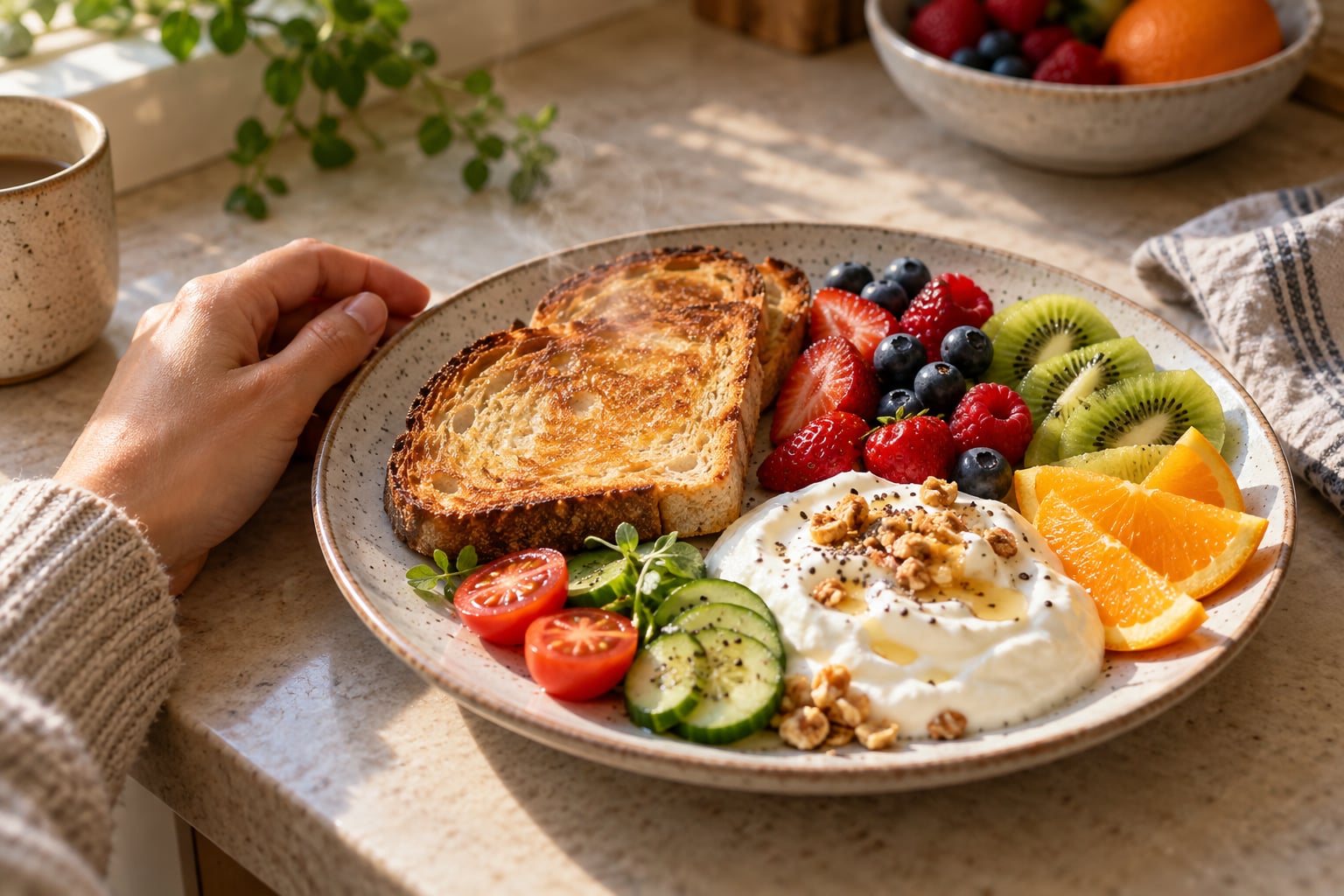
Advice to eat well can feel hard to use when most suggested foods are not foods you eat. Trying to change a whole meal at once can feel like too much. You need a way to work with what already feels familiar.
Map what works, strengthen familiar meals, then try one voluntary change at a time.
Identify accepted foods and the traits you want to keep constant.
Look for ways to build on meals you already eat without changing their identity.
Keep accepted traits in place while changing one sensory variable.
Gather information about a food without making liking or swallowing the goal.
Put familiar meals and small, voluntary experiments into a plan.
The guide has 10 chapters. The first two are shown in full below, so you can judge whether the approach fits before buying.
A safe food is simply a food you can count on. You know how it will taste, how it will feel in your mouth, and what needs to happen for it to be acceptable. It might need to be one particular shape, served very hot, kept away from sauce, or made from the same familiar product each time. Those details are not silly. They are useful information about what lets you eat with less strain.
Adult picky eating does not have one neat explanation. Some people are especially sensitive to flavour or texture. Some have a long history of being pressured at the table. An unfamiliar food may bring anxiety, while a familiar one brings relief. Other people simply have strong preferences and a short list of foods they enjoy. None of that tells you whether someone is mature, adventurous, disciplined, or grateful.
It helps to put the usual goal aside. You do not have to become someone who happily eats everything. A kinder and more practical goal is to make eating support your day with less stress. That could mean packing a lunch you can reliably finish, adding something filling beside a familiar breakfast, or having a backup for a restaurant meal.
If toast is breakfast, keep the toast. If plain pasta is the one dinner that works after a tiring day, keep enough pasta in the cupboard. Removing a dependable food before another option is truly dependable can leave you hungry and make the next attempt feel much harder.
Start by noticing what your current foods already give you:
That is your starting material. Later, you can look for gaps and additions. For now, the point is to see what already holds up in real life.
Picture a plate of crisp oven fries with exactly the right browned edges. If those fries are dependable, they can sit beside a tiny sample of another potato preparation one day. They can also remain exactly as they are. Their value does not depend on whether they lead anywhere else.
Trying a bite is only one possible step, and it may not be the first one. You might feel more comfortable with an unfamiliar food on the table but not on your plate. You might discover that the smell is fine while the lumpy texture is not. You might strengthen a meal you already like by putting smooth yogurt or an egg alongside it. You might find one new cracker that is acceptable enough to keep buying.
All of those outcomes give you something useful. Even a clear rejection can narrow down what went wrong. Was it the temperature, the mixed texture, a strong flavour, or the pressure of eating in front of somebody? That answer is more helpful than a verdict that you are simply “bad with food.”
Before you move on, choose one result you would genuinely welcome. Keep it small and tied to daily life:
“I want one breakfast that keeps me comfortable until lunch.”
“I want a backup snack I can carry to work.”
“I want to find out whether smooth fruit textures are easier than fresh fruit.”
“I want restaurant meals to feel less uncertain.”
You are allowed to choose ease as the outcome. Once you know what would make eating a little better, you can build toward it without putting your reliable foods at risk.
Once your dependable foods are protected, you can look at what they add up to. You do not need to inspect every plate or track numbers. A meal can be plain, repeated, and still give you a steady mix of food across the day.
Think about four broad parts:
These are prompts, not requirements for every meal. The balance of your eating matters more across a day or week than it does on one carefully arranged plate. Breakfast might be cereal with milk, while fruit turns up later as a smooth pouch or sliced apple. Dinner might be pasta and cheese, with peas accepted only at lunch. It can still fit together.
Start with the meal you eat most often. Look at what is already present, then consider the smallest addition that would fit without changing the part you rely on.
| Part to consider | Familiar examples | Low-friction additions |
|---|---|---|
| Starch | Toast, pasta, white rice, potatoes, crackers | An extra slice of toast, oats stirred into an accepted smooth food, a higher-fibre version if its texture works |
| Protein | Eggs, yogurt, cheese, beans, chicken | A cheese stick beside crackers, yogurt beside cereal, an egg beside potatoes, smooth bean dip in its own bowl |
| Fruit, vegetables, or fibre | Peeled apple, banana, peas, corn, oats | A small fruit cup, frozen peas served separately, canned corn, an accepted fortified cereal |
| Flavour or richness | Butter, oil, cheese, smooth dip | Olive oil on pasta, grated cheese on the side, a familiar dressing in a separate dish |
You may already have more than you thought. Beans bring protein and fibre. Yogurt can add protein alongside crisp cereal without changing the cereal itself. A warm bowl of oats is both a starchy base and a source of fibre. The table is a way to notice options, not a demand to fill four boxes.
Some additions can make a meal last more comfortably until the next one. If toast alone leaves you hungry soon after, you could keep the toast exactly as you like it and add a boiled egg, a yogurt, cheese, or smooth nut butter, depending on what you accept. If adding anything to the toast would spoil its dry crunch, put the extra food beside it.
Fresh produce is only one form of fruit and vegetables. Frozen peas, canned corn, smooth applesauce, peeled cucumber, or fruit blended to an even texture may be much more predictable. Official food guidance includes fresh, frozen, canned, dried, and juiced forms. They are not identical in taste or texture, which is exactly why one form may work when another does not.
Fortified foods can also quietly widen what a familiar menu contains. “Fortified” means nutrients have been added during production. Breakfast cereal and some dairy alternatives are common examples. If you depend on one specific food, check its label before swapping it, since similar-looking products can differ and the taste may change. A tolerated fortified cereal is still a sensible food; it does not need to become a bowl of something visibly virtuous.
Convenience belongs here too. Frozen rice, canned beans, single-serve yogurt, sliced bread, and ready-cooked eggs can make the difference between eating and skipping a meal. The form that reliably reaches your plate is the useful one.
A quick scan can be gentler than grading one meal. Write down yesterday's breakfast, lunch, dinner, and snacks. Circle the starches, underline foods with protein, and put a small mark beside fruit, vegetables, beans, oats, or whole grains. You are looking for the part that rarely appears.
If protein is usually missing, choose one accepted protein to place beside a regular meal. If fruit and vegetables are scarce, begin with the form that seems least disruptive, even if that is canned, smooth, peeled, or frozen. If meals are being missed, regular access to a dependable food comes first.
Concerns about a deficiency, unexplained physical changes, or a very narrow diet need individual advice rather than guesswork. A doctor or registered dietitian can assess your particular intake and health. This guide stays with general food ideas, where the aim is one manageable addition to a meal you already eat.
You have read chapters 1 and 2 of 10: Start With Food That Already Works and Build a Nutrition Safety Net. The rest covers sensory rules, familiar meals, food bridges, taste experiments, shopping, social situations, stalls, and a first two-week plan.
Keep your safe foods as the foundation instead of treating them as a failure.
Focus on strengthening meals you already accept before relying on new foods.
Use a one-change experiment to notice what works, even if you do not like or swallow the food.
The 31-page PDF covers safe-food mapping, familiar meals, one-change food bridges, low-pressure experiments, predictable shopping and prep, eating around other people, and a first two-week plan.
$3.97
Get the plan31-page PDF · no subscription · works on any device
You can keep facing meal ideas that ask for too much at once, or start with the foods that already work for you.