 Hush Pantry
Quiet, practical food advice
Hush Pantry
Quiet, practical food advice
Hush Pantry
Quiet, practical food advice
Hush Pantry
Quiet, practical food advice
For beginner households who want a simpler way to use the produce they have. A downloadable 29-page PDF.
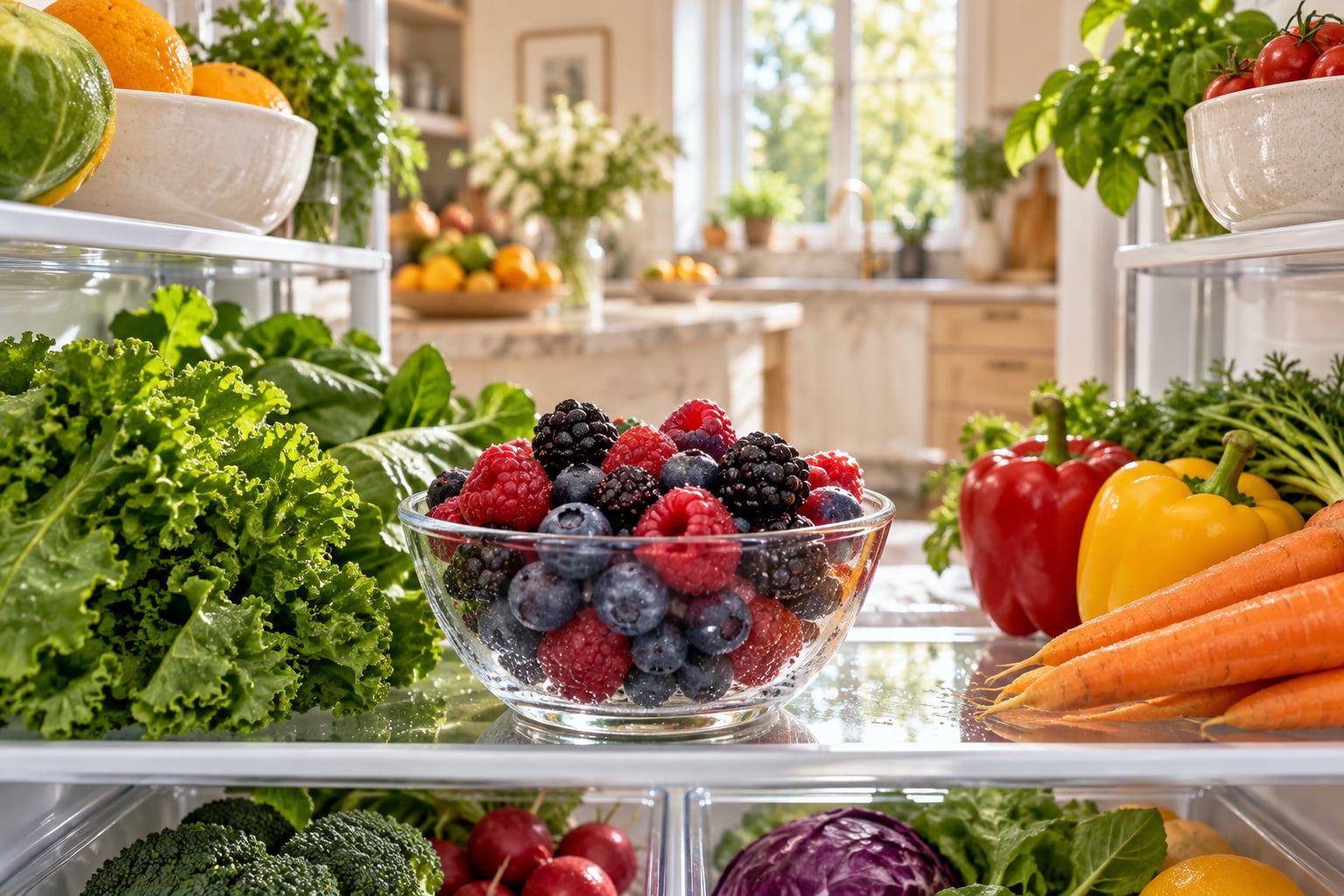
You buy produce with good intentions, then lose track of it behind other food. Deciding what to use next becomes another task. A perfect meal plan is a lot to ask when you just need to see what's there.
Set up a visible use-first zone, check produce by condition, and give urgent items a believable next action.
Tie a brief fridge check to an existing weekly trigger instead of relying on perfect meal planning.
Make produce that needs attention visible without reorganizing the whole fridge.
Look at condition and likely remaining life, not purchase date alone.
Give each urgent item a believable next action rather than planning an ambitious recipe.
Decide when the freezer is a useful next step instead of a place to postpone the decision.
The guide has 10 chapters. The first two are shown in full below, so you can judge whether the approach fits before buying.
A full refrigerator can hide perfectly appealing food. A tub at the front blocks the spinach behind it. A new punnet of berries lands in front of the older one. A few mushrooms slip to the back of a deep shelf, where they stop being dinner and become a surprise several days later.
The food has not disappeared, of course. It has simply left the part of the fridge you notice when you are hungry and short on time. That matters because the easiest ingredient to use is often the one you can see. When produce stays hidden, you lose a quick handful of greens for pasta, crisp carrots for lunch, or ripe fruit for breakfast. You may also buy another bag because the first one was out of sight when you wrote the list.
The EPA's household guidance recommends looking through the refrigerator, freezer, and pantry before shopping, then noting what needs to be used. Its household food-waste toolkit also encourages a designated refrigerator area for food that needs eating relatively soon. That practical idea is the starting point here.
Pick an eye-level spot that comes into view as soon as the door opens. It might be the front half of a shelf, a shallow bowl, or one clear container you already own. This is your use first zone: a short queue for edible food that needs a decision soon.
Keep it deliberately small. The zone is for the half cucumber, ripe pear, opened bag of greens, or leftover roasted vegetables that could fit into an upcoming meal. It is not a second crisper drawer, and it does not need to hold every vegetable in the house. Sturdy cabbage and whole carrots can remain where they store well until their condition says otherwise.
Visibility comes before tidiness here. An opaque lidded box may contain food neatly while hiding it just as effectively as the back shelf did. If food needs a container, use a clear one when you have it. If a plate or bowl works safely, that is enough.
The location also has to respect safe storage. Do not build the zone beneath anything that could drip onto ready-to-eat produce, and do not move chilled food into a warmer spot simply because it is more visible. Later, we will set the safety boundaries around the whole fridge. For now, choose a small place you naturally look, clear it, and leave it ready for the weekly scan.
You are not committing to a recipe when something enters this zone. You are only bringing it back into the conversation. A ripe pepper in sight is much easier to imagine blistered in a pan, folded through eggs, or sliced beside a sandwich than one buried behind three jars.
The best moment for this reset is the one that already fits your week. If you usually write a shopping list on Friday night, open the fridge first. If groceries arrive on Sunday morning, do the reset on Saturday. The exact day matters less than giving the check a familiar place to land.
Household food-waste guidance consistently joins these two actions: look through what you have, then write the list around it. Utah State University Extension also recommends keeping leftovers in an accessible refrigerator spot so people remember what is available. The reset turns that advice into a compact routine you can finish before another task pulls you away.
Set a timer for ten minutes. Put one tray, chopping board, or clear patch of counter beside you. It is only a temporary decision space, not somewhere food will sit for the afternoon.
| Time | What to do | What you are looking for |
|---|---|---|
| 0:00 to 2:00 | Open and scan | Cut produce, ripe fruit, tender greens, leftovers with vegetables, and anything partly hidden |
| 2:00 to 4:00 | Remove and check | Food that is questionable, leaking, moldy, slimy, or otherwise needs a closer safety decision |
| 4:00 to 6:00 | Gather candidates | A small group that needs using now or soon, placed on your temporary tray |
| 6:00 to 8:00 | Choose next actions | Eat as is, add to a meal, cook, freeze while sound, or discard safely |
| 8:00 to 10:00 | Update the list | Cross off what you already own and note one smaller, sturdier, frozen, or skipped purchase |
Start with a scan rather than pulling out every shelf. Look at the front, then glance behind taller containers and into the drawers. You are checking for food that needs attention, not cataloguing every mustard jar.
Next, move only the likely candidates to your tray. The temporary surface keeps a soft courgette from travelling from shelf to shelf while you decide what to do with it. It also lets you see the whole handful together: perhaps spinach, two ripe tomatoes, half an onion, and berries. That is enough to suggest garlicky greens beside dinner, tomatoes and onion folded into eggs, and berries spooned onto breakfast.
Questionable food gets its own decision. Reducing waste does not mean trying to rescue everything. If an item is unsafe or you cannot establish that it has been stored safely, discard it. Section three gives you clearer boundaries between fading quality and spoilage.
For each sound candidate, choose one next action. Keep it small and ordinary. “Add spinach to Tuesday pasta” is more likely to help than saving three new spinach recipes. “Eat berries at breakfast” is enough. If you will not use something while it is still in decent shape, freezing may be the more honest choice.
Finish at the shopping list. Cross out ingredients you found. Add quantities where that helps, such as “greens for two lunches” rather than “greens.” If the crisper still holds carrots, you have one easy side already waiting: roast them until the edges darken, or grate them into a sharp lemony salad.
Some weeks will not offer ten quiet minutes. Keep the same order and shorten the search:
Stop there. Do not begin scrubbing shelves or reorganizing condiments. Cleaning a spill is sensible, but a full fridge clean is a separate afternoon. The reset is done when you have a short visible queue and a shopping list that reflects the food already at home.
It can also be shared. One person can scan while another writes the list or names the meals coming up. What matters is that the decisions happen before the shop, while the sweet pepper is still crisp enough for lunch and the herbs can still brighten tonight's soup.
You've read chapters 1 to 2 of 10: why produce gets overlooked and how to install the weekly reset. The rest covers urgency, storage, dinner clues, freezing, buying habits, and household sticking points.
Keep produce in view with a small use-first zone.
Set priorities by condition and likely remaining life, with food safety taking priority.
Use an urgent item as a clue instead of building a perfect meal plan around it.
The 29-page PDF covers the weekly reset, use-first zone, produce urgency, safe and visible storage, dinner clues, freezer decisions, shopping habits, and ways to fix a household sticking point.
$3.97
Get the guide29-page PDF · no subscription · works on any device
Without a place to see what needs using, it's easy to keep making the same guess each time you open the fridge.